Borrow a Telescope. See Something Amazing.
You do not need to own a telescope — or know anything about astronomy — to spend an evening exploring the Universe.
Find a Telescope Near You
Library Telescopes are available through participating Hampton Roads library systems. Borrowing rules, loan periods, holds, and eligibility are established by each library, so use the links below for current availability and checkout information.
Virginia Beach Public Library
VB001 · Orion StarBlast 4.5
Meyera E. Oberndorf Central Library
4100 Virginia Beach Blvd, Virginia Beach, VA 23452
Virginia Beach Public Library
VB002 · Orion StarBlast 4.5
Meyera E. Oberndorf Central Library
4100 Virginia Beach Blvd, Virginia Beach, VA 23452
Instructions for Your Telescope
The BBAA defers to the Library Telescope Program's current official instructions, videos and manuals. Their guide covers the Apertura Library Telescope and notes that Orion StarBlast operation is very similar.
Official Library Telescope Getting-Started GuideYour First Night
- Start simple. The Moon is usually the easiest first target. Jupiter and Saturn are also excellent when visible.
- Begin with low power. A wide field of view makes objects easier to find.
- Use the red-dot finder. Line up the finder with the object, then look through the eyepiece.
- Focus slowly. Turn the focus control gently until stars are as small and sharp as possible.
- Give your eyes time. Avoid bright white lights while observing.
Good Things to See Tonight
Our Hampton Roads observing guide highlights objects that are rewarding now. Use it for a short curated list, then open Stellarium if you want to explore the whole sky.
What Will It Really Look Like?
Astronomy photographs are built by collecting and processing light over seconds, minutes, or even hours. Your eye works very differently. Through a Library Telescope, most objects will appear smaller and subtler than photographs — but the experience is immediate. You are looking directly at the object.
The Moon — bright, sharp, richly detailed.
Jupiter — a small disk, often with visible cloud bands and moons.
Saturn — small, unmistakable, rings plainly visible when conditions cooperate.
Orion Nebula — a pale glowing cloud around bright young stars.
Star clusters — often spectacular, especially from darker skies.
Observing in Hampton Roads
Dew happens.
Warm, humid nights can leave moisture on exposed surfaces. If the telescope becomes damp, do not wipe dew from the mirrors or optics. Bring the telescope inside and allow it to dry naturally.
Haze matters.
A night can be technically clear but still hazy enough to wash out faint objects. The Moon and planets often remain excellent targets.
Darker helps — but is not required.
You can enjoy the Moon, planets, double stars, and bright clusters from suburban neighborhoods. Fainter galaxies and nebulae improve dramatically under darker skies.
Be cautious near the coast.
Avoid exposing the telescope to blowing sand, salt spray, or other abrasive environments.
Never Point the Telescope at the Sun
Never look at or near the Sun through this telescope. Permanent eye damage can occur almost instantly. Library Telescopes are intended for nighttime observing and are not solar telescopes.
Need Help? Bring It to Skywatch.
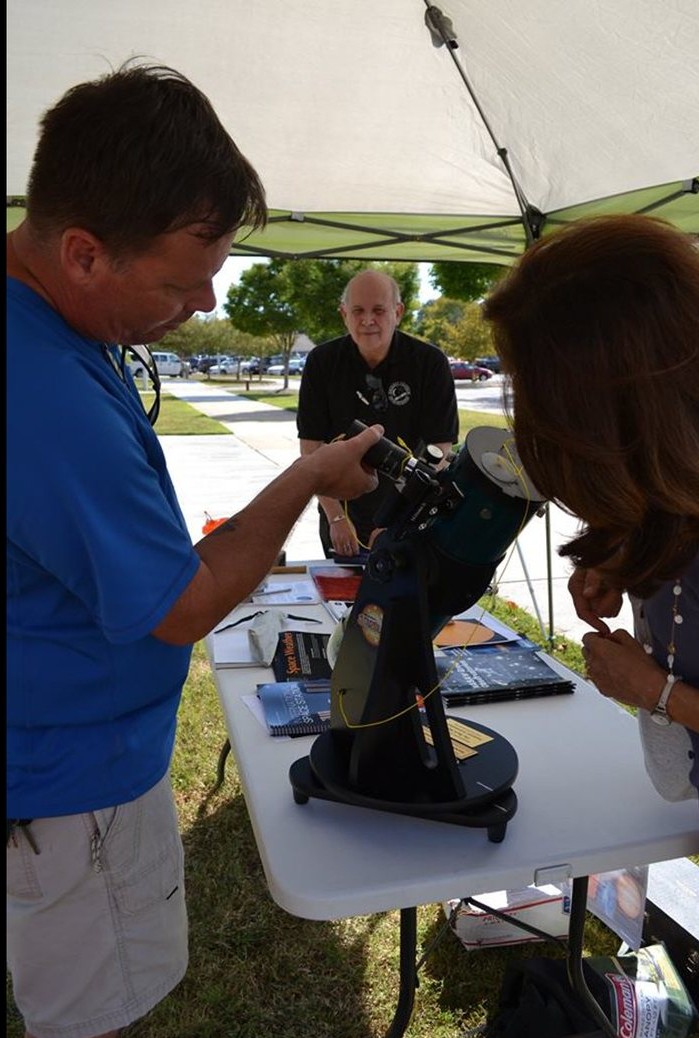
If you borrowed a telescope and cannot figure something out, bring it to a BBAA Skywatch. Volunteers can help you set it up, use the finder, focus properly, choose magnification, identify objects, and get comfortable using the telescope.